

Expert Stove & Oven Repair in Watertown, MA
Appliance Repair for Homes & Businesses in Watertown, Nonantum, New Town, Auburndale, Massachusetts and Nearby Areas
Stove and Oven Repair in Watertown, Massachusetts | Appliance Repair Pros
A broken stove or oven in Watertown disrupts more than just dinner plans; it throws off your entire household routine. Whether you are baking in a renovated kitchen near Watertown Square or cooking on a vintage gas range in a historic home in Nonantum, you need your cooking appliances to work safely and predictably. Appliance Repair Pros provides specialized stove and oven repair services to homeowners throughout Watertown, Auburndale, and Newton Corner. We address common issues like burners that click but will not light, ovens that burn your food due to temperature spikes, and electric cooktops that refuse to heat. Our team understands the mix of gas and electric appliances found in local homes, from older pilot light systems to modern induction cooktops. We arrive prepared to diagnose the issue safely, respecting your home with clean work habits and clear explanations. Contact us today to get back to cooking with confidence.
Stove and Oven Repair Services in Watertown
Cooking appliances are the workhorses of the kitchen. They operate at high temperatures and, in the case of gas units, deal with combustible fuel. This makes professional repair essential for both performance and safety. We work on a wide variety of cooking equipment configurations found in Watertown households.
Cooking systems we work on
- Gas ranges and standalone stoves
- Electric coil and glass top ranges
- Wall ovens (single and double)
- Gas and electric cooktops
- Dual fuel ranges (gas cooktop, electric oven)
- Slide-in and freestanding units
- Induction cooktops
- Range hoods and downdraft systems
What makes stove and oven repair tricky
- Gas Safety: Working with gas valves, regulators, and supply lines requires strict leak testing.
- High Voltage: Electric ranges often run on 240 volts, posing significant electrical risks.
- Ignition Systems: Diagnosing between a faulty spark module, electrode, or igniter requires specific testing.
- Temperature Sensors: Calibrating an oven requires testing resistance in the sensor and the control board.
- Control Boards: Modern ovens are computerized and sensitive to heat and power fluctuations.
- Door Locks: Self-cleaning cycles rely on motorized locks that can jam and trap your food inside.
- Glass Tops: Radiant elements are hidden beneath fragile glass that requires careful handling.
Common Stove and Oven Problems We Fix
Gas burner clicks but will not light
This is one of the most common complaints we receive from Watertown homeowners with gas ranges. You hear the clicking sound of the spark electrode, but the flame never catches. It can happen to one burner or all of them at once.
Likely causes
- Clogged burner ports from food spills
- Misaligned burner cap
- Weak spark module
- Cracked spark electrode
- Moisture in the burner assembly
How we diagnose it
We check the quality of the spark. If it is yellow or weak, it may not be hot enough to ignite the gas. We inspect the gas flow to the burner and check for physical blockages in the gas tube or burner head.
What you can do right now
Remove the burner cap and clean the metal burner head with a toothbrush to remove dried grease. Ensure the cap is sitting perfectly flat.
Oven is not heating (Gas)
You turn the oven on, but it stays cold. In a gas oven, you might hear a faint glow or click, but the main burner never ignites. This is usually due to a safety feature preventing gas release without a verified ignition source.
Likely causes
- Weak glow bar igniter
- Failed safety valve
- Bad temperature sensor
- Control board relay failure
How we diagnose it
We test the amperage draw of the igniter. Most gas ovens use a glow bar that must pull a specific amount of current to open the gas valve. If it glows but is too weak, the gas will never turn on.
What you can do right now
Check if your stovetop burners are working. If they are not, you might have a gas supply issue to the house. If they are, the issue is inside the oven.
Oven is not heating (Electric)
In electric ovens, a lack of heat is often a direct component failure. You might notice the broil element works but the bake element does not, or neither works at all.
Likely causes
- Burnt out heating element (visible breaks)
- Tripped internal thermal fuse
- Broken wire connection
- Failed infinite switch or relay board
How we diagnose it
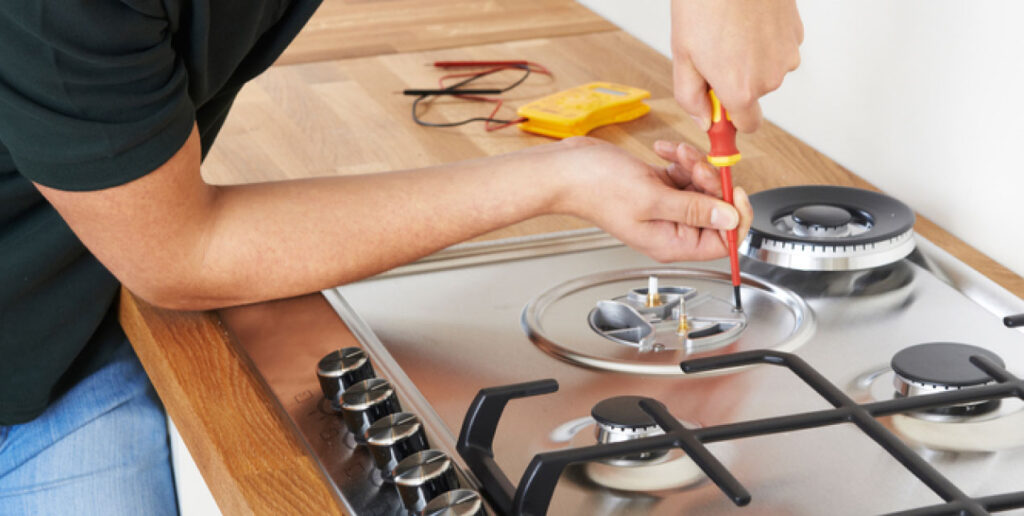
We use a multimeter to test the continuity of the hidden bake element or the exposed coil. We also check the voltage arriving at the element to see if the board is sending power.
What you can do right now
Look closely at the heating element. If you see blisters, breaks, or dark spots, the element likely burned out and needs replacement.
Oven temperature is inaccurate
If your cookies are burning on the bottom before they are done on top, or if a roast takes an hour longer than expected, your oven calibration is likely off.
Likely causes
- Faulty temperature sensor probe
- Control board needing calibration
- Worn door gasket letting heat escape
- Blocked airflow in convection models
How we diagnose it
We measure the resistance of the temperature sensor at room temperature. We also inspect the door seal for gaps. We can often recalibrate the control board offsets to match the actual temperature.
What you can do right now
Buy an inexpensive oven thermometer and place it inside. Compare its reading to what you set the oven to. Note the difference.
Glass cooktop element not working
On a smooth top electric range, a burner that stays dark is a major inconvenience. Sometimes it might turn on but go to high heat instantly regardless of the setting.
Likely causes
- Burned out ribbon element
- Failed infinite switch (control knob)
- Loose wire in the harness
- Surface element limiter failure
How we diagnose it
We access the components under the glass. We test the switch to see if it is regulating power correctly. If the element runs hot constantly, the switch is usually the culprit.
What you can do right now
Reset the breaker. Sometimes one leg of the 240-volt power is lost, causing the lights to work but the heating elements to stay cold.
Oven door will not open
This typically happens after running a self-cleaning cycle. The high heat engages a safety lock, and if the mechanism fails or the sensor reads the temperature incorrectly, the door remains locked forever.
Likely causes
- Failed door lock motor assembly
- Bad temperature sensor reading “too hot”
- Warped door latch
- Control board logic error
How we diagnose it
We carefully access the lock mechanism, usually from the back or top, to manually release it without damaging the door. We then test the lock motor and sensor.
What you can do right now
Let the oven cool down completely for at least 2 hours. Sometimes the sensor just needs time to register a safe temperature.
Strong smell of gas
This is a safety priority. If you smell gas while cooking, it could be unburned fuel. If you smell it when the unit is off, it is a leak.
Likely causes
- Leaking gas valve
- Cracked supply line
- Delayed ignition causing gas buildup
- Extinguished pilot light (in very old models)
How we diagnose it
We use electronic gas detectors and bubble solutions to locate the exact source of the leak, whether it is at the regulator, the valve, or the connection to the wall.
What you can do right now
If the smell is strong, turn off the gas at the main valve, open windows, leave the house, and contact your utility company immediately.
Control panel not responding
You press “Bake” or “Start” and nothing happens, or the display is flickering. This is common in modern ovens with touchpad interfaces.
Likely causes
- Touchpad ribbon cable corrosion
- Control board failure
- Child lock activated
- Short circuit in the interface
How we diagnose it
We test the inputs from the membrane switch. If the buttons are not registering, the touchpad usually needs replacement. If the display is dark, it is often a power supply issue on the main board.
What you can do right now
Turn the breaker off for 5 minutes and turn it back on. This “hard reset” can sometimes clear temporary logic glitches.
Safety Notes for Stove and Oven Issues
Ranges and ovens involve high heat, electricity, and often explosive gas. Safety is paramount when dealing with these appliances. Ignoring signs of trouble can lead to fire hazards or carbon monoxide issues.
- If you smell rotten eggs (Gas Leak) do this first: Do not use any electrical switches or phones in the kitchen. Shut off the gas valve if safe to do so, leave the home, and call the gas company from outside.
- If you see sparks inside the oven do this first: Turn off the oven immediately. This is usually a heating element arcing and can melt the liner. Turn off the breaker.
- If a grease fire starts on the cooktop do this first: Do not use water. Turn off the burner and cover the pan with a metal lid or use a fire extinguisher rated for grease.
- If the glass cooktop cracks do this first: Stop using it immediately. Liquids can seep through the crack and reach the high voltage components below, creating a shock hazard.
- If the oven keeps heating uncontrollably do this first: This is a “runaway temperature” condition. Shut off the power at the circuit breaker immediately, as the controls are failing to stop the heat.
Brands We Service for Stove and Oven Repair in Watertown
From the robust ranges found in family homes to the precision cooktops in chef-inspired kitchens, we handle all major brands. We carry the testing equipment necessary for both domestic and foreign models.
Whirlpool family and similar designs (Whirlpool, Maytag, KitchenAid, Amana)
These units are staples in Watertown. They often share ignition systems and control logic. KitchenAid ranges often feature heavy-duty commercial styling that requires specific disassembly steps.
Common issues we see with these models
- “Spark module” failure causing continuous clicking
- Control board relay failure leading to no heat
- Door hinge springs breaking
- Temperature sensor drifting out of calibration
Why diagnosis matters
On Whirlpool gas ovens, a weak igniter is the number one cause of no-heat, but it is often misdiagnosed as a bad gas valve. Testing amperage confirms the real culprit.
GE family (GE, Hotpoint, and related lines)
GE ranges are known for their durability and specific “glow bar” ignition systems. The Profile and Café lines introduce complex dual-fuel systems and probe cooking that adds layers to the repair process.
Common issues we see with these models
- Glow bar igniter burning out
- F3 or F9 error codes
- Surface element switches failing
- Convection fan noise
Why diagnosis matters
GE units often have a specific safety circuit involving the thermal fuse. If the fuse blows, the oven goes dead. We find out why it overheated before just replacing the fuse.
Samsung and LG
These brands offer feature-rich ovens with dividers, dual doors, and smart connectivity. The electronics in these units are sophisticated and require a multimeter capable of testing low-voltage data signals.
Common issues we see with these models
- Uneven baking in dual-convection modes
- Touchscreen failures
- Burners lighting but not staying lit
- Control knobs breaking (plastic stems)
Why diagnosis matters
Samsung gas ranges often use a specific orifice design. If the flame is yellow or lifting, it might be an airflow adjustment rather than a broken part.
Frigidaire and Electrolux
Common in many local condos and apartments, these units are generally reliable but have known issues with their electronic oven controls (EOC) and surface elements.
Common issues we see with these models
- Bake element burning a hole in the bottom pan
- F1 error code (Control board failure)
- Surface burner thermal limiter failure
Why diagnosis matters
Frigidaire electric ranges often hide the bake element under the floor. Diagnosing a bad element requires removing the floor panel, not just looking inside.
Bosch and Thermador
These high-end units are common in Watertown’s renovated kitchens. They often feature “Star” burners (Thermador) or complex simmer circuits that require specialized knowledge to service.
Common issues we see with these models
- Simmer burner clicking continuously
- Relay board failure
- Cooling fan noise
- Door seal degrading
Why diagnosis matters
These units often have separate spark modules for different burners. Identifying which channel is bad saves you from replacing the expensive main module unnecessarily.
Understanding Common Oven Error Codes
When your oven detects a problem, it often displays a code starting with “F” or “E”. These are helpful starting points, but they are not the final answer. We use them to guide our physical testing.
- F1 (Universal): Often indicates a stuck key on the touchpad or a failed control board.
- F3 / F30 / F31: Typically points to an open or shorted oven temperature sensor.
- F9 (Universal): Door lock circuit failure. Common after self-cleaning cycles.
- F0 / F-0: Keypad failure or communication error between boards.
- F2: Over-temperature condition. The oven got too hot, likely due to a stuck relay.
- c-d0 / c-d1 (Samsung): Door or divider sensor errors.
- F11 (Whirlpool/Kenmore): Shorted key on the membrane switch.
- F5 (GE): Electronic control failure or power supply issue.
Maintenance Tips for Stove and Oven Owners in Watertown
Keeping your cooking appliances clean and maintained prevents many common breakdowns. Given the popularity of gas cooking in Watertown, keeping burners clear is especially important.
- Clean spills immediately: Sugary or acidic spills (like tomato sauce) can eat into the enamel of the oven floor if left to bake on repeatedly.
- Avoid using foil on the bottom: Never line the bottom of a gas oven with foil. It blocks airflow and can cause carbon monoxide buildup or melt onto the liner.
- Clean burner ports: Use a paper clip or needle to gently clear the tiny holes in gas burner heads to ensure an even flame and proper ignition.
- Check the door gasket: Feel around the edge of the oven door while it is running (carefully). If you feel hot air escaping, the seal is worn and needs replacement to save energy.
- Be careful with self-clean: The extreme heat of the self-clean cycle is the number one cause of component failure (fuses and boards). Use it sparingly or stick to manual cleaning.
- Clean the range hood filter: A clogged grease filter restricts airflow, which is vital for removing heat and smoke from your kitchen.
- Respect the glass top: Do not slide cast iron pans across a glass cooktop. The scratches can weaken the glass and lead to cracking under heat.
- Check gas line flexibility: If you pull your stove out to clean, ensure the flexible gas line isn’t kinked or pinched when you push it back.
Service Area for Stove and Oven Repair in and Around Watertown, MA
We are a locally focused team serving the diverse neighborhoods of Watertown and the surrounding communities. Whether you are in the dense streets near Victory Field or the quieter residential areas of Auburndale, we are close by. We are familiar with the parking logistics and the specific housing types in the area, from triple-deckers to single-family ranchers.
- Watertown
- Nonantum
- Auburndale
- Newton Corner
- Belmont
- West Cambridge
- Waltham
- Newtonville
- East Watertown
Zip codes we serve: 02472, 02471, 02458, 02466, 02453, 02477
Frequently Asked Questions
Is it safe to use my oven if the glass is cracked?
If the outer door glass is cracked, the oven is still functional but the exterior will get dangerously hot. If the inner glass or the glass cooktop is cracked, do not use it. It disrupts heat distribution and, on cooktops, poses a shock hazard.
Why does my gas oven smell like gas when I turn it on?
A slight smell of gas for a few seconds during ignition is normal. However, if the smell persists or if you smell it while cooking, the igniter may be weak, taking too long to light the gas, or there may be a leak. This requires professional inspection.
Should I repair or replace my 15-year-old stove?
Gas ranges often last 15-20 years. If the issue is a simple igniter or sensor, repair is very cost-effective. If the oven floor is rusted through or parts are obsolete, replacement is better. Electric glass tops are expensive to fix; if the glass breaks on an old unit, replacement is usually the wiser choice.
Why does my oven take so long to preheat?
In a gas oven, this is a classic sign of a weak igniter. It is hot enough to open the valve slowly but not fully. In an electric oven, it usually means one of the heating elements (bake or broil) has failed, and the oven is trying to reach temperature using only one element.
Do you calibrate ovens?
Yes. If your oven is consistently 20 degrees too hot or too cold, we can adjust the offset in the control board settings. We can also verify if the thermostat itself is defective.
Why won’t my gas burner light after I cleaned it?
Moisture is the enemy of ignition. If water got into the spark electrode or burner ports, the spark will short out or the gas won’t flow correctly. Let it dry out completely. If it still fails, the electrode may have cracked during cleaning.
What should I do before the technician arrives?
Please ensure the stove is cool. Clear any pots and pans from the cooktop and remove any baking sheets from inside the oven. If the unit is built into a cabinet, please clear the cabinet contents so we can access the power cord or gas line.
Can you fix a vintage stove in my older Watertown home?
We service many older models, but parts availability is the limiting factor. If it is a classic antique (like a 1950s O’Keefe & Merritt), we may recommend a specialist. For standard units from the 90s and 2000s, we can usually help.
Why is my convection fan making noise?
Over time, the bearings in the convection fan motor dry out, or the fan blade becomes loose and rattles. This noise will only get louder and eventually, the fan will seize. It is best to replace the motor assembly.
Is the self-cleaning cycle dangerous?
It is not inherently dangerous if the oven is working correctly, but it is extremely stressful on the appliance components due to temperatures exceeding 900 degrees. We recommend manually cleaning with mild cleaners to extend the life of your control board and sensors.
Do you service dual fuel ranges?
Yes, we work on dual fuel units which typically combine a gas cooktop with an electric oven. These require a technician who is skilled in both gas safety and electrical diagnostics.
Why does my electric burner stay on high?
This is caused by a failed “infinite switch” behind the control knob. The internal contacts have welded together, sending full power to the element regardless of the knob position. This needs immediate repair as it is a fire hazard.
Conclusion
Appliance Repair Pros is your local expert for keeping your kitchen cooking safely and efficiently. We understand that a malfunctioning stove or oven is a major disruption to your life in Watertown. Our team combines rigorous safety protocols with expert diagnostics to fix the problem right the first time. Whether you have a gas range that won’t light or an electric oven that won’t heat, we have the skills to resolve it. Reach out to us for assistance and let us restore the heart of your kitchen.


